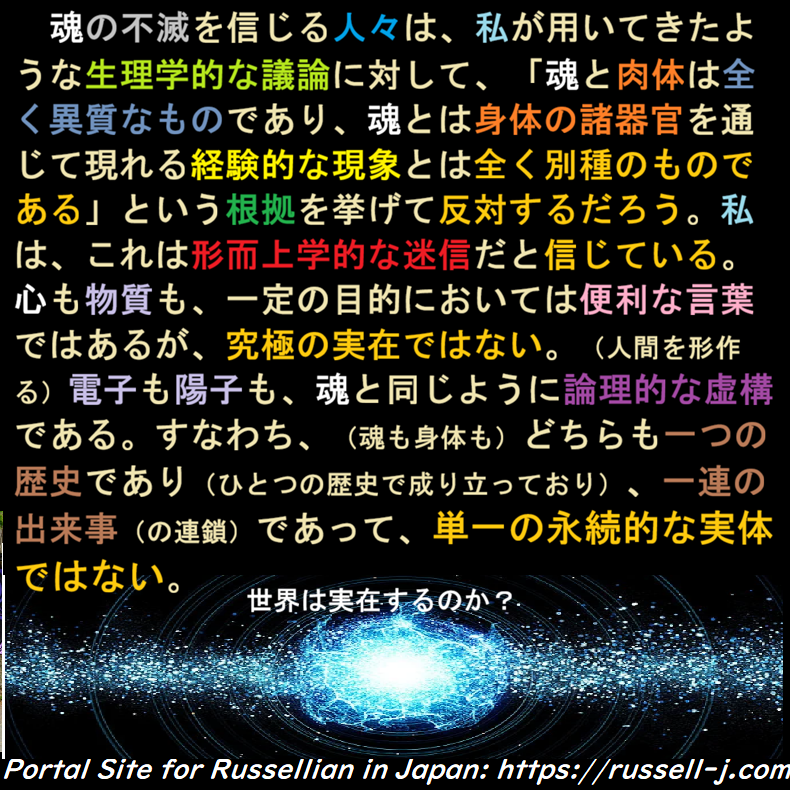
魂の不滅を信じる人々
魂の不滅を信じる人々は、私が用いてきたような生理学的な議論に対して、「魂と肉体は全く異質なものであり、魂とは、身体の諸器官を通じて現れる経験的な現象とは全く別種のものである」という根拠を挙げて反対するだろう。私は、これは形而上学的な迷信だと信じている。心も物質も、一定の目的においては便利な言葉ではあるが、究極の実在ではない。(人間を形作る)電子も陽子も、魂と同じように論理的な虚構である。すなわち、(魂も身体も)どちらも一つの歴史であり(ひとつの歴史で成り立っており)、一連の出来事(の連鎖)であって、単一の永続的な実体ではない。
Believers in immortality
Believers in immortality will object to physiological arguments, such as I have been using, on the ground that soul and body are totally disparate, and that the soul is something quite other than its empirical manifestations through our bodily organs. I believe this to be a metaphysical superstition. Mind and matter alike are for certain purposes convenient terms, but are not ultimate realities. Electrons and protons, like the soul, are logical fictions; each is really a history, a series of events, not a single persistent entity.
Source: What I Believe, 1925
<寸言:「魂」はどこからやってくるのか?――ラッセルと現代物理学が描く「私」の正体>
私たちの身体を含め、あらゆるものは物質の最小単位である「素粒子」からできています。現代物理学の標準的な理論では、素粒子は「大きさのない点」とされますが、最新の「超弦理論」などでは、それは極小の「ひも」が特定のリズムで刻んでいる「振動の状態」に過ぎないとされています。つまり、私たちが「固い実体」だと思っているものは、実は楽器の弦が奏でる音色のような「現象」なのです。
そう考えると、「死んでも魂は残る」という素朴な信仰は、科学的に見て大きな矛盾に突き当たります。受精卵が細胞分裂を繰り返し、複雑な神経系を築き上げ、脳という精緻なネットワークが形作られていくプロセスにおいて、一体どの瞬間に、外部から「魂」という特別な何かが入り込んでくるというのでしょうか? 意識とは、脳という生体組織が高度な情報処理を行う中で自然に立ち上がってくる「機能」であり、どこか別の場所から持ち込まれる「部品」ではないはずです。
哲学者バートランド・ラッセルが100年も前に喝破した通り、「心」も「肉体」も、それ自体が独立して存在する究極の実在ではありません。どちらも特定の文脈で使うと便利な「言葉」に過ぎず、ラッセルはこれを**「論理的虚構(logical fictions)」**と呼びました。
電子や陽子、そして私たちの魂。それらは不変の「モノ」ではなく、刻一刻と変化し続ける「履歴(history)」であり、「出来事の連なり」なのです。
私たちは(私たち人間も)、川の流れそのものが一定の形を保っているように見えるのと同じで、絶え間なく入れ替わる素粒子と情報が作り出す、一時の「パターンの束」に過ぎません。「死んでも魂は残る」と信じることは、川が干上がった後も「川の形」だけがどこかに浮遊していると信じるような、形而上学的な迷信なのかもしれません。
Refractions on Bertrand Russell's "What I Believe"
Everything, including our own bodies, is composed of elementary particles?the smallest units of matter. In the standard model of modern physics, these particles are treated as "dimensionless points." However, theories such as "Superstring Theory" suggest they are actually infinitesimal "strings" vibrating at specific frequencies. In other words, what we perceive as "solid substance" is, in fact, a phenomenon?much like the timbre of a musical string.
When viewed this way, the naive belief that "the soul survives after death" encounters a profound scientific contradiction. As a fertilized egg undergoes repeated cell division, building a complex nervous system and eventually the intricate network of the brain, at what exact moment is a special, external "soul" supposedly injected? Consciousness is a "function" that emerges naturally from the high-level information processing of the brain's biological structure; it is not a "component" brought in from elsewhere.
As the philosopher Bertrand Russell astutely pointed out a century ago, neither "mind" nor "matter" exists as an independent, ultimate reality. Both are merely convenient terms used in specific contexts?what Russell called "logical fictions."
Electrons, protons, and our souls alike are not persistent, unchanging "things." Each is truly a "history," a continuous "series of events."
We?including we human beings?are like a river that appears to maintain a constant shape even as its waters flow and change. We are nothing more than a temporary "bundle of patterns" created by the ceaseless flux of particles and information. To believe that the soul remains after death may be a metaphysical superstition?not unlike believing that the "shape of a river" continues to hover in the air long after the riverbed has run dry.
 ラッセル関係電子書籍一覧 |
 ラッセル関係電子書籍一覧
#バートランド・ラッセル #Bertrand_Russell